
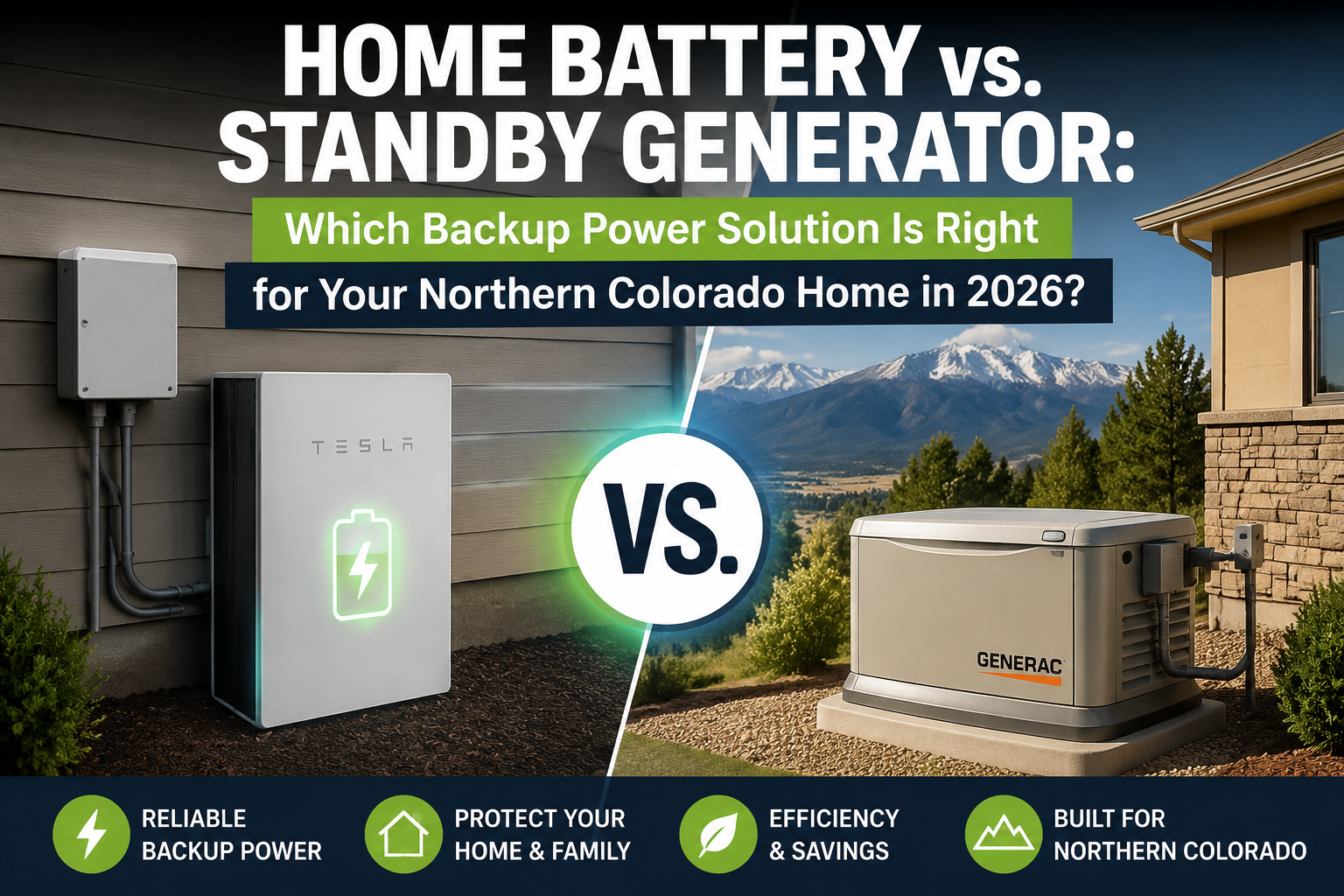
| QUICK ANSWER For most Northern Colorado homes, the choice comes down to outage length and lifestyle. A home battery system delivers instant, silent, fuel-free backup for essential circuits — ideal for the short-to-medium outages typical along the Front Range, and it pairs with solar to recharge during extended events. A natural gas standby generator delivers unlimited runtime for whole-home coverage, making it the choice for rural Weld County properties, well pumps, and multi-day worst-case planning. Many homeowners now combine both: battery for seamless daily protection, generator for endurance. Either path requires a licensed electrician, a transfer switch or backup interface installed to code, and permits — a proper load assessment tells you which solution actually fits your panel and priorities. |
Ask anyone in Greeley, Windsor, or Fort Collins about the last few years of weather and you’ll hear the same stories: bomb-cyclone winds, summer thunderstorms that knock out half the neighborhood, ice storms, and wildfire seasons that put the whole grid on edge. Add record demand on Colorado’s electrical system, and backup power has moved from doomsday-prepper territory to one of the most common questions we get as electricians. The good news: 2026 is the best time in history to protect your home, because you finally have two mature options — home batteries and standby generators. The tricky part is that the right answer genuinely depends on your home, your property, and what you need to keep running. Here’s the honest comparison.
Why Are Northern Colorado Homeowners Investing in Backup Power Now?
- Weather isn’t getting calmer. High winds, ice, and summer microbursts remain the leading causes of Front Range outages — and repair times stretch when crews are handling hundreds of calls across Weld and Larimer counties.
- Wildfire-season shutoffs are real. During high-risk fire weather, utilities can preemptively de-energize lines. Even when your home isn’t threatened, your power can be — sometimes for many hours.
- The cost of downtime has grown. More of daily life runs on electricity than ever: remote work, medical devices, refrigerated medications, sump pumps, EV charging, and electric heat. A 6-hour outage in 2026 costs more than it did in 2016.
- Sump pumps fail at the worst time. Finished basements across Northern Colorado depend on sump pumps exactly when storms hit — the same moment the grid is most likely to fail. Backup power is cheap insurance against a five-figure flood.
Battery vs. Generator: The Head-to-Head Comparison
| Factor | Home Battery System | Natural Gas Standby Generator |
| Power during outage | Instant — no flicker, electronics never notice | 10–30 second automatic transfer |
| Runtime | Hours to days (sized by capacity); recharges from solar | Unlimited while gas supply flows |
| Noise | Silent | Comparable to a running A/C unit |
| Fuel & maintenance | None; minimal upkeep | Utility gas hookup; annual service, weekly self-tests |
| Coverage | Essential circuits (or whole-home with larger systems) | Whole-home coverage is standard |
| Everyday value | Daily use: solar storage, time-of-use savings | Standby only — value appears when grid fails |
| Best fit | Urban/suburban homes, solar owners, short-medium outages | Rural properties, well pumps, multi-day resilience |
Notice what the table doesn’t say: that one option “wins.” They solve different problems. The right question isn’t “which is better” — it’s “which outage am I actually protecting against, and what must stay on when it happens?”
Which Solution Fits Your Home? Three Northern Colorado Scenarios
The Greeley or Windsor Suburban Home
City gas and water service, typical outages measured in hours, priorities like the fridge, furnace fan, Wi-Fi, and a home office. A right-sized battery covering essential circuits handles the realistic outage profile silently and instantly — and if you have or plan solar, the battery earns its keep every single day, not just during emergencies.
The Rural Weld County Property
Well pump, possibly a shop or livestock infrastructure, and longer restoration times at the end of a rural line. Well pumps are power-hungry, and multi-day self-sufficiency matters out here — this is standby generator territory, with automatic transfer so the property protects itself even when you’re away.
The Solar Home (or Soon-to-Be)
Here’s what surprises most solar owners: standard grid-tied solar shuts off during an outage for line-worker safety. Panels alone won’t power your house when the grid is down. Adding a battery changes that completely — solar charges the battery by day, the battery runs your essentials by night, indefinitely for moderate loads. For extended worst-case planning, some homeowners layer a generator behind the battery for a system that’s seamless, silent, and effectively unlimited.
| Not Sure Which Way to Go? Start With a Load Assessment. Efficiency-1 designs and installs battery backup and standby generator systems across Greeley, Windsor, Evans, Fort Collins, Loveland and rural Weld County — sized to what your home actually needs, installed to code, permits handled. Request Your Free Backup Power Assessment at efficiency-1.com |
What Does a Professional Backup Power Installation Involve?
- Load assessment and priorities. An electrician walks your panel and home, calculates loads, and asks the question that sizes everything: what must stay on — everything, or the essentials? Oversizing wastes money; undersizing disappoints during the first real outage.
- Transfer equipment — the safety core. Batteries need a code-compliant backup interface or sub-panel for protected circuits; generators need an automatic transfer switch that isolates your home from the grid. Both exist to protect you and utility line workers — this is the piece DIY installs get dangerously wrong.
- Permits, gas work, and inspection. Backup power installations require electrical permits and inspection in Greeley, Weld County, and surrounding jurisdictions; generators add gas-line work and placement/setback rules. A licensed contractor handles all of it.
- Placement and mounting. Batteries mount in a garage or utility area with clearances per code; generators sit on an exterior pad with proper setbacks from windows and property lines. Placement affects noise, service access, and inspection sign-off.
- Commissioning and testing. Simulated-outage testing, app setup for monitoring, and a walkthrough so you know exactly what happens the moment the grid drops. Generators get a maintenance schedule; batteries get charge-priority settings tuned to your utility rates.
Common Backup Power Mistakes to Avoid
- The portable-generator-in-the-garage plan. Portable units create carbon monoxide deaths every storm season, and backfeeding a panel through a dryer outlet can electrocute line workers. If a solution involves an extension cord through a window, it isn’t a solution.
- Buying capacity before calculating load. A battery that dies in 3 hours or a generator that can’t start the well pump means the system failed its only job. Sizing math comes first, brand shopping second.
- Skipping permits. Unpermitted transfer equipment risks your insurance coverage, complicates resale, and skips the inspection that catches life-safety errors. There is no honest shortcut here.
- Assuming solar equals backup. Grid-tied panels without a battery give you zero outage protection. If backup is part of why you’re going solar, design the battery in from day one — retrofits cost more.
Frequently Asked Questions
How long will a home battery run my house during an outage?
It depends on capacity and what you’re powering. A typical single-battery system runs essential circuits — fridge, furnace fan, lights, internet, sump pump — for many hours to a day or more. Paired with solar, it recharges daily and can carry essentials through extended outages. Whole-home coverage requires larger multi-battery systems.
Do standby generators really start by themselves?
Yes — that’s the point. An automatic transfer switch detects the outage, starts the generator, and shifts your home over within seconds, whether you’re asleep or out of town. It reverses automatically when the grid returns, and the unit self-tests weekly.
Will my solar panels power my home during a blackout?
Not by themselves. Standard grid-tied systems shut down during outages to protect utility workers. You need a battery with backup capability (or a special inverter setup) to use solar power when the grid is down — one of the most common surprises we clear up for Northern Colorado solar owners.
Do I need a permit for a generator or battery in Greeley?
Yes. Both require electrical permits and inspection, and standby generators typically involve gas permits and placement setbacks as well. Licensed contractors handle the paperwork — unpermitted installs create insurance and resale problems and skip critical safety review.
Can I add a battery to my existing solar system?
Usually yes. The approach depends on your current inverter — some systems accept batteries directly, others use AC-coupled batteries that work alongside any solar setup. An assessment of your existing equipment gives the answer quickly.
What keeps running matters most — what should I prioritize?
For most Front Range homes: heat (furnace fan or boiler controls — critical in winter), refrigeration, sump pump, a few lights and outlets, internet, and any medical equipment. Central A/C and EV charging are comfort adds that drive system size up quickly. Your load assessment turns this list into hard numbers.
| The Next Outage Is Coming. Your House Doesn’t Have to Notice. Efficiency-1 designs battery, generator, and solar-plus-storage backup systems for Northern Colorado homes — licensed, permitted, and sized to your real loads, from Greeley to the Front Range. Schedule Your Free Assessment at efficiency-1.com |