
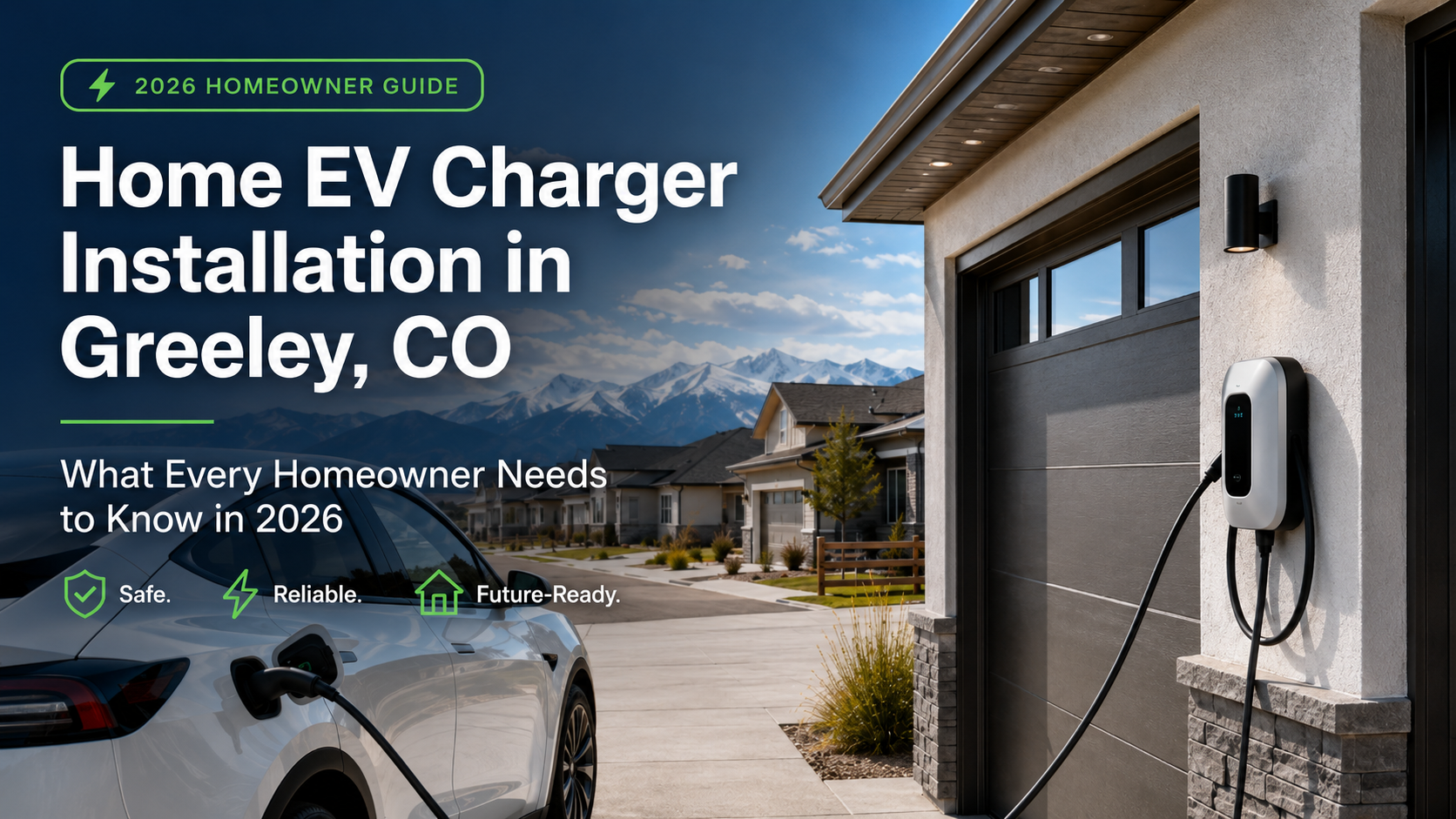
| Quick Answer For daily EV driving, a professionally installed Level 2 home charger is the 2026 standard — it charges your vehicle overnight (4–10 hours) versus 24+ hours on a regular outlet. Installation requires a dedicated 240V circuit, an electrical permit, and a licensed electrician who verifies your panel can safely handle the load. In Greeley and Weld County, Efficiency-1 — a licensed, Tesla and Enphase authorized installer — handles the entire process, from panel assessment to final inspection. Call 720-736-5895 for a free estimate. |
Drive through any neighborhood in Greeley, Evans, or Windsor in 2026 and you’ll notice something that barely existed five years ago: electric vehicles in almost every other driveway. Colorado has become one of the fastest EV-adopting states in the country — and every one of those vehicles needs somewhere to charge.
Here’s what most new EV owners discover within the first two weeks: public charging is fine in a pinch, but real EV ownership starts at home. Waking up every morning to a full battery, at a fraction of what public fast-charging costs, is the single biggest quality-of-life upgrade an EV owner can make. The catch? Getting home charging done safely — and legally — is not a DIY weekend project. This guide covers everything Greeley homeowners need to know before installing a home EV charger.
Why Is Home EV Charging Such a Big Deal in 2026?
Over 80% of all EV charging happens at home, according to the U.S. Department of Energy — and for good reason. Charging overnight on off-peak electricity rates costs far less than public fast-charging stations, and you never have to plan your week around finding an open charger.
For Northern Colorado specifically, there’s another factor: winter. Cold weather temporarily reduces EV range, which means Greeley drivers rely on consistent overnight charging even more than owners in milder climates. A home Level 2 charger means your vehicle pre-conditions and charges in your own garage — no scraping ice at a public charging stall at 6 a.m.
Level 1 vs Level 2 Charging: What’s the Difference?
Every EV can technically charge from a standard household outlet — but “can” and “should” are different things. Here’s the honest comparison:
| Factor | Level 1 (Standard Outlet) | Level 2 (Professionally Installed) |
| Power source | Regular 120V household outlet | Dedicated 240V circuit |
| Charging speed | 3–5 miles of range per hour | 25–40+ miles of range per hour |
| Full charge time | 24–50+ hours | 4–10 hours (overnight) |
| Best for | Plug-in hybrids, very light driving | Daily EV drivers — the standard for home charging |
| Installation | None — but slow and can strain shared circuits | Licensed electrician, permit, and inspection required |
The math is simple: if you drive more than about 30–40 miles a day, Level 1 charging can’t keep up. That’s why a dedicated Level 2 charger has become the default choice for nearly every EV household in 2026 — including Tesla owners, whose Wall Connector requires the same professional 240V installation.
Can Your Home’s Electrical Panel Handle an EV Charger?
This is the question that matters most — and the one most homeowners can’t answer on their own. A Level 2 charger typically draws 32–48 amps on its own dedicated circuit. Many homes in Greeley and across Weld County, especially those built before the 1990s, still run on 100-amp panels that are already working hard powering HVAC, kitchen appliances, and modern electronics.
Signs your panel may need attention before an EV charger goes in:
- Your panel is rated 100 amps or less, or still uses fuses instead of breakers.
- Breakers trip when multiple large appliances run at the same time.
- Lights flicker or dim when the A/C, dryer, or microwave kicks on.
- You’re also planning other electrical additions — a hot tub, workshop, or solar.
A licensed electrician performs a load calculation to determine whether your existing panel can safely support the charger, or whether a panel upgrade is the smarter long-term move. Sometimes a smart load-management device can avoid an upgrade entirely — but only a proper assessment can tell you that. Guessing wrong isn’t just inconvenient; an overloaded panel is a genuine fire risk.
Do You Need a Permit to Install an EV Charger in Greeley?
Yes. Installing a 240V EV charging circuit in Greeley and throughout Weld County requires an electrical permit and inspection, and the work must meet the National Electrical Code (NEC) requirements for EV supply equipment. This is one of the biggest reasons to avoid handyman installs or DIY attempts:
- A permitted installation protects your home insurance — unpermitted electrical work can void claims if anything ever goes wrong.
- The inspection confirms the circuit, wiring gauge, breaker, and GFCI protection are all correct for continuous high-amperage charging.
- The paper trail matters at resale — buyers and inspectors in 2026 specifically look for documented, code-compliant EV infrastructure.
A licensed electrical contractor handles the permit, the installation, and the inspection for you — it’s part of the job, not an extra headache for the homeowner.
What Rebates and Incentives Can Colorado Homeowners Use in 2026?
Good news for Greeley homeowners: EV charger installation is one of the most incentivized home upgrades in Colorado right now. Depending on your situation, you may qualify for a federal tax credit for home EV charging equipment and installation, utility rebate programs for Level 2 chargers and wiring, and Colorado’s state-level home energy programs — Efficiency-1 is an authorized participant in the Colorado Home Energy Rebates program through the Colorado Energy Office.
Incentive programs change frequently and eligibility depends on your utility, income bracket, and equipment choice — so the smartest first step is having your installer walk you through what you currently qualify for. That guidance is part of every Efficiency-1 estimate.
What Does Professional Installation Actually Look Like?
A proper Level 2 installation by a licensed electrician follows a clear sequence:
1. Free Assessment and Load Calculation
The electrician evaluates your panel capacity, the distance from panel to charging location, and your vehicle’s charging specs to recommend the right amperage and equipment.
2. Permit and Scheduling
Your contractor pulls the electrical permit with the local authority — no paperwork on your plate.
3. Installation Day
A dedicated 240V circuit is run from your panel to the charger location, with correctly sized wire, breaker, and required protection. Most standard installations are completed in a single visit.
4. Inspection and Walkthrough
The work is inspected and signed off, then your electrician tests the charger with your vehicle and shows you how to schedule off-peak charging to keep your electricity costs low.
Why Choose Efficiency-1 for EV Charger Installation in Greeley?
- Licensed and insured Colorado electrical contractor serving Greeley, Evans, Windsor, Loveland, and greater Weld County — with 12+ years of experience and a 4.9-star customer rating.
- Tesla and Enphase authorized installer — factory-authorized for Tesla Wall Connector and Enphase equipment, so your charger, and even future solar, come from one accountable team.
- Authorized participant through the Colorado Energy Office’s Home Energy Rebates program, helping you capture every incentive you qualify for.
- 24/7 availability with quick response times, free estimates, and service en Español.
Frequently Asked Questions
How long does EV charger installation take?
Most standard installations are completed in one visit of a few hours. Jobs requiring long wire runs, trenching to a detached garage, or a panel upgrade take longer — your free assessment will give you an exact timeline before any work begins.
Can I install an EV charger myself?
Legally and safely, no — a 240V continuous-load circuit requires a permit, code-compliant wiring, and inspection. DIY electrical work at this amperage risks fire, voided insurance, and failed home inspections at resale. This is a job for a licensed electrician.
Will an EV charger work with solar panels?
Yes — and it’s an increasingly popular combination in Northern Colorado. Charging your EV from your own rooftop solar is the cheapest driving “fuel” available. As an Enphase-authorized installer that handles both solar and EV charging, Efficiency-1 can design the two systems to work together.
What if I don’t own an EV yet but I’m planning to buy one?
Pre-wiring for a future charger during any other electrical work — a panel upgrade, remodel, or new garage circuit — is significantly easier and more economical than a standalone visit later. Many Greeley homeowners now pre-wire simply to future-proof their home’s value.
Ready to Charge at Home? Let’s Get You Set Up
An EV without home charging is a phone without a charger by your bed — it works, but you’re doing it the hard way. A professionally installed Level 2 charger pays you back every single morning in convenience, savings, and peace of mind.
| Get Your Free EV Charger Installation Estimate Efficiency-1 — Licensed Colorado Electrical Contractor | Tesla & Enphase Authorized Installer. Serving Greeley, Evans, Windsor, Loveland & all of Weld County. Call 720-736-5895 or book online at efficiency-1.com/book-an-appointment. 24/7 availability — we speak Spanish. |